Last month, a founder showed me his influencer “report.” It was a folder of 40 screenshots. Lots of likes. Zero idea what any of it sold.
I see this a lot. Brands spend real money on creators, then guess at the results.
And the spending keeps climbing. A Kofluence report expects India’s influencer industry to cross Rs 4,500 to 5,000 crore by the end of 2026. In 2025, it was Rs 3,000 to 3,500 crore.
An influencer collaboration strategy helps you choose which creators to work with. What they’ll post, how much you’ll pay, and how you’ll measure results. Start with what you want the campaign to achieve.
Start by asking what you want from the collaboration. Are you trying to get your name out there, bring in inquiries, or sell more? Then look for creators who speak to your target audience. Spend some time reading their comments and checking their audience. A big follower count alone might not tell you much, and it’s often misleading. Before the work starts, agree on what they’ll post, what you’ll pay, and how they’ll disclose the partnership. Give each creator a tracking link or discount code. You can check what comes from their posts.
What Makes an Influencer Collaboration Strategy Work in 2026?
It works when each creator post is tied to one goal and one way to track it. That’s the whole secret, honestly.
Everything else is detail. Important detail, sure. But brands that skip this part end up with screenshot folders.
Brands are planning to spend more on influencer marketing. According to the Influencer Marketing Hub Benchmark Report 2026, 87.49% of respondents who answered the budget question expect their influencer marketing budgets to increase in 2026. That shows an appetite to spend more. Whether your next sponsored reel gets noticed is another matter.
The audience isn’t limited to big cities, either. Kofluence points to growing influencer activity in India’s Tier-3 and Tier-4 cities. If you’re trying to reach Telugu-speaking customers around Warangal, a local food creator may be a better fit than a celebrity in Mumbai. It depends on who you want to reach.
My honest view? Skip the celebrity post. I’d rather pay five micro creators for three months.
When people see the same face talk about your product repeatedly, they start to believe it. One big post just gives you a nice Tuesday.
How Do You Set Goals and a Budget for an Influencer Campaign?
Choose one main goal first. Then pick the creator tier that suits it, and let that decide your budget.
Clients often ask me to generate awareness and sales from the same reel. It rarely happens. A reel made to go wide isn’t the reel that gets people to fill a form.
Here’s a rough guide to the tiers.
| Tier | Followers | Good for | The catch |
|---|---|---|---|
| Nano | 1,000 to 10,000 | Local shops, product seeding | Small reach |
| Micro | 10,000 to 100,000 | Leads and city-level trust | Quality varies a lot |
| Mid-tier | 100,000 to 500,000 | Regional reach | Busier calendars, higher fees |
| Macro | 500,000 to 1 million | Launches | Engagement drops |
| Celebrity | 1 million plus | Mass awareness | Expensive, hard to track sales |
One thing in your favor. Creators still like free products. The Aspire State of Influencer Marketing 2025 report says 57% of creators planned to raise rates. Yet 83% would still work for products from a brand they love.
So I typically start by sending products to a dozen nano creators. Then I pay the few whose followers actually respond.
Keep some money back, too. When one post clearly works, run it as a paid ad from the creator’s handle.
How Do You Find and Vet the Right Influencers?
Look for creators your buyers already follow. Then check their audience data before you sign a thing.
Follower count? Honestly, it’s the least useful number on the profile.
Instagram is still the main hunting ground. In the Influencer Marketing Hub report, 57% of brands called it their favorite platform for this work.
Finding the right person can feel like hunting for the needle in a haystack. I keep the vetting simple. First, I ask for a screenshot of their Instagram Insights, top cities and age groups. If a Hyderabad salon’s creator has mostly Delhi viewers, that’s a no.
Then I read the comments. The actual words written. Real fans ask, “Where is this shop?” Bots leave three fire emojis plus leave.
I also scroll back a month. If every second post is an ad, the audience has stopped listening.
A restaurant client in Hyderabad had a food creator in mind because she had a huge following. But when we checked her audience data, most of her viewers were outside Telangana. We chose three smaller creators with local audiences. Their posts brought in bookings that weekend.
What Are the Steps to Run an Influencer Collaboration?
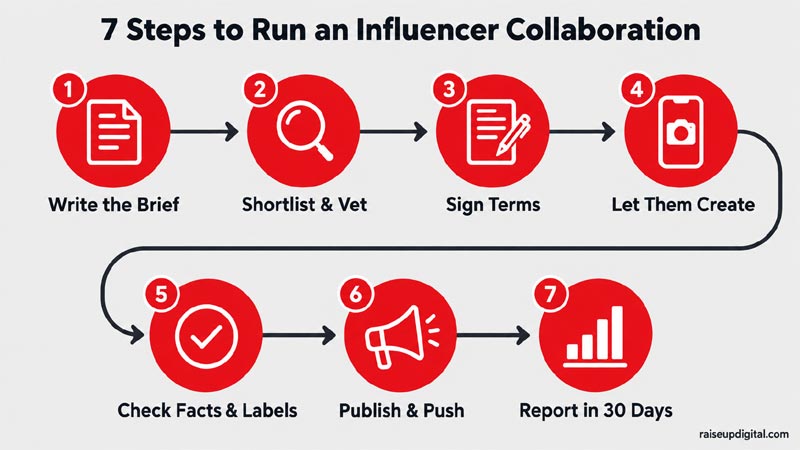
Use the same seven steps for every collaboration. It saves you from chasing creators on WhatsApp at 11 pm.
- Give the creator a short brief. Tell them about the product, what you want from the campaign, and when the post should go live. Mention anything they need to include.
- Take a closer look before choosing. Read the comments on their recent posts and check who follows them. Keep a couple of other creators in mind in case your first choice is unavailable.
- Write down what you’ve agreed. This includes the fee, number of posts, deadlines, and disclosure. Also agree on whether you can reuse the content and for how long.
- Let them handle the creative part. Give them the information they need without putting every word in their mouth. Their followers came for their content, not your sales presentation.
- Check the draft before it goes live. Correct any wrong product details or unsupported claims. Make sure the partnership is disclosed. You don’t need to change every sentence to match your brand’s usual wording.
- Share the content from your own page. Once the post is live, reshare it. If it gets a good response, consider running it as an ad after agreeing on usage rights with the creator.
- Check what came from each partnership. Within 30 days, review the clicks, discount code use, and sales you could track. This gives you something to work with when planning the next campaign.
If you’d rather not juggle all this yourself, our influencer marketing team at Raise Up Digital in Hyderabad runs it end to end.
What Disclosure Rules Do Influencers Follow in India?
Any paid or gifted post needs a clear label under ASCI guidelines. These rules kicked in on June 14, 2021.
The Advertising Standards Council of India (ASCI) accepts labels like “Ad”, “Sponsored”, “Collaboration”, or “Free Gift”. They apply whenever the brand and creator have a material connection. Free products count.
Where do brands slip? Usually in small ways. The label gets hidden in a pile of hashtags. Or the creator thinks one line in their bio covers everything. It doesn’t.
Live streams have their own rule. The creator has to say it’s sponsored at the start and again at the end.
Add disclosure clauses to every contract. A missing label can become an angry Twitter thread by lunchtime.
And if something does blow up, move fast. Good online reputation management stops a small fire from spreading.
How Do You Measure Influencer Campaign ROI?
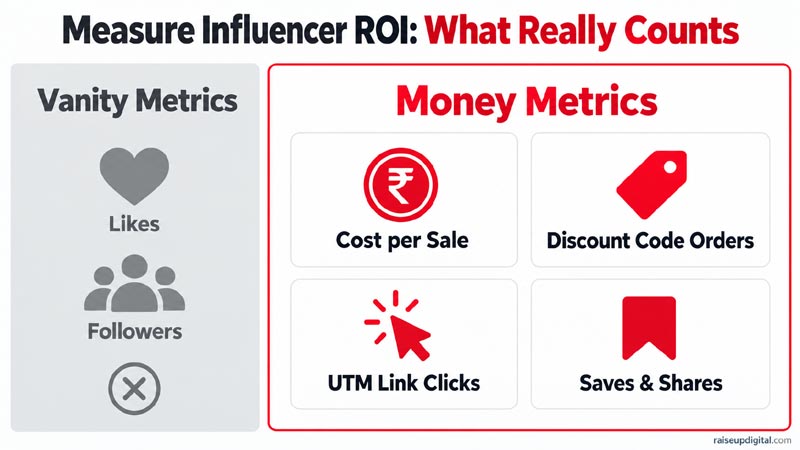
Track leads or sales for each creator, not likes. A unique discount code and a UTM link per creator will do most of the work.
Likes are nice. They just don’t pay salaries.
I look at cost per sale first. Take the creator’s fee, divide by orders from their code, and you know who earned their money. Google Analytics 4 shows link clicks from the UTM tags.
Saves and shares tell me more than likes. People save things they plan to buy. And I check Google Search Console for brand searches during the campaign. When those rise, the creators are working even without clicks.
So, which creator would you happily book again tomorrow?
That gut answer, backed by the numbers, is your next campaign. Sign them for longer. Let the others go.
Key Takeaways
- Decide what you want each post to do. If it’s meant to bring sales, give the creator a separate link or discount code so you can track them.
- Before spending the whole budget on one celebrity post, consider working with a few smaller creators over three months. Compare the results rather than assuming a bigger name will sell more.
- Check where their followers live and spend a few minutes reading the comments. A large audience is useful only if it includes people who might buy from you.
- Make the paid partnership clear from the start. Follow ASCI’s disclosure guidelines and keep the label easy to spot. Do not bury it among hashtags.
- For sales campaigns, work again with creators who brought in orders. If someone didn’t deliver, look at what went wrong before spending more on another post.
Frequently Asked Questions
How much should a small business in India spend on influencer marketing in 2026?
There’s no fixed amount. Start with a test budget you’re okay losing. Most small brands begin with nano and micro creators. You could offer products plus a small fee. Spend more only once a creator brings in real sales.
Are micro influencers better than celebrities for a small brand?
For most small brands, yes. Micro creators cost less and their fans tend to trust them more. Celebrities get you seen, but their sales are hard to trace.
How long should an influencer collaboration last?
Start with one paid post and see how it performs. If the creator is a good fit and the response is supportive, try working together for three months. That gives you time to test different posts and see whether the results hold up.
Do Instagram influencers in India have to label paid posts?
Yes. ASCI guidelines require disclosure for paid promotions. Readers should be able to spot a label such as “Ad” or “Sponsored” without hunting through hashtags. Free products can also require disclosure, even when no money changes hands.
How can I tell if an influencer has fake followers?
Review several posts rather than judging one. Repeated generic comments or sudden follower increase without further engagement are reasons to investigate. Ask for audience insights, including location and age. Emojis alone don’t prove anything. Real people love a fire emoji too.
Planning creator campaigns for your brand? Our team at Raise Up Digital in Gachibowli, Hyderabad, works with Indian and global brands on exactly this. Drop us a message and tell us what you’re selling.

I bring 15+ years of experience in SEO, helping businesses across industries grow their organic visibility and improve website quality. My work spans enterprise, technical and local SEO, GEO, AEO, content strategy, and link building. I also handle site quality assessments, backlink audits, traffic drop investigations, and manual action recovery.
Alongside consulting, I train professionals and teams in SEO and AI search, turning complex concepts into practical skills they can use.